
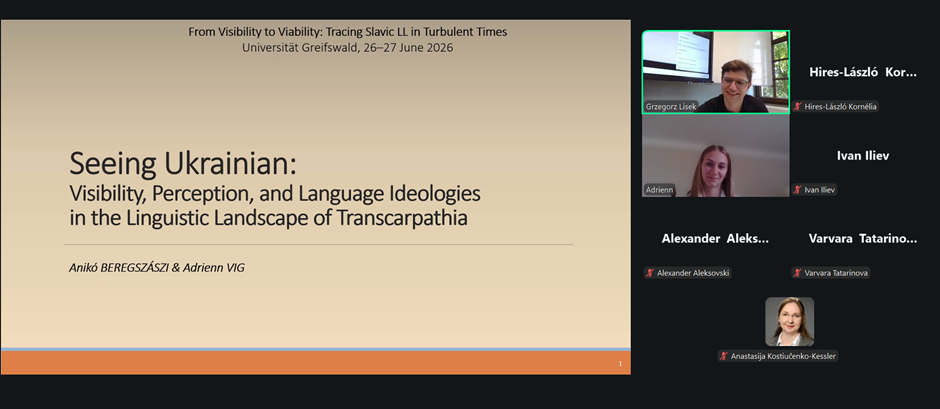

The Institute of Slavonic Studies at the University of Greifswald organised an international academic conference entitled From Visibility to Viability: Tracing Slavic LL in Turbulent Times between 26 and 27 June 2026. The event focused on current issues in linguistic landscape research, the public visibility of linguistic processes in Central and Eastern Europe, and the visible linguistic consequences of war, migration, language policy and social change.
The conference placed particular emphasis on the visibility of the Ukrainian language, the role of Slavic languages in the linguistic landscape, and the social, ideological and political processes that shape the presence of languages in public spaces. During the two-day programme, researchers from several countries presented their latest empirical findings and theoretical approaches.
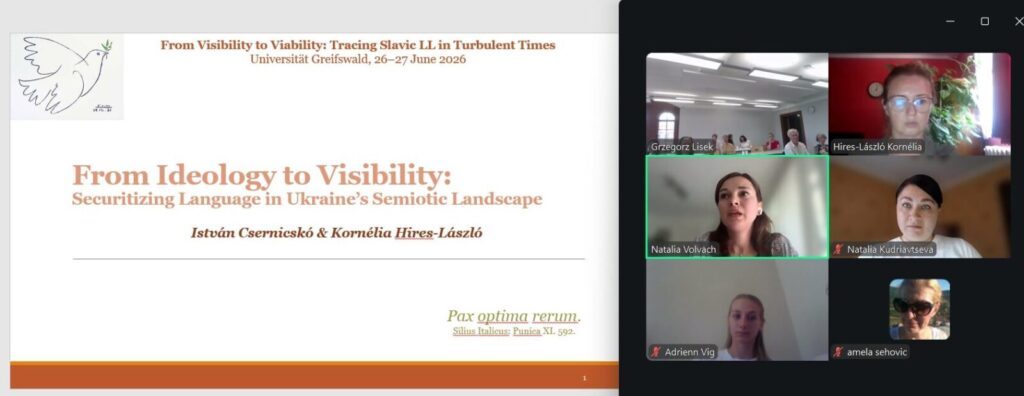
The staff members of the Antal Hodinka Linguistic Research Centre and the researchers of Ferenc Rákóczi II Transcarpathian Hungarian College of Higher Education represented the institution with two presentations at the international conference. On 26 June, in the panel devoted to war, occupation and securitisation in the linguistic landscape, István Csernicskó and Kornélia Hires-László delivered a presentation entitled From Ideology to Visibility: Securitizing Language in Ukraine’s Semiotic Landscape. Their presentation examined how language-policy ideology, the discourse of national security and the protection of the state language become visible in Ukraine’s semiotic and linguistic landscape.
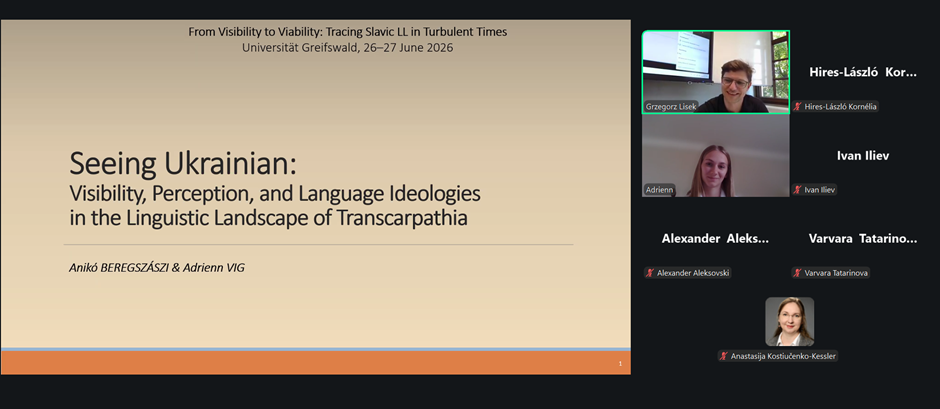
On 27 June, in the section focusing on the visibility, perception and language attitudes related to Ukrainian and East Slavic languages, Anikó Beregszászi and Adrienn Vig presented their paper entitled Seeing Ukrainian: Visibility, Perception, and Language Ideologies in the Linguistic Landscape of Transcarpathia. Their research analysed the visibility of the Ukrainian language, its social interpretation and the related language ideologies through the linguistic landscape of Transcarpathia.
The aim of the participation was to present the analysis of the Transcarpathian minority linguistic landscape in an international academic context, and to enable the staff members of the research centre and the university researchers to engage with current European discourses in linguistic landscape studies through their presentations. The conference also provided an opportunity for the researchers to gain experience in an international comparative context regarding the study of minority-language visibility, language-policy changes and the transformation of multilingual spaces.
Participation in the Greifswald conference contributed to making the linguistic, educational and social processes affecting the Hungarian community in Transcarpathia interpretable within the broader research contexts of Central and Eastern Europe.