
Antal Hodinka (Ladomér, 12 January 1864 – Budapest, 15 July 1946) was a world-renowned scholar of the Rusyns in Hungary, a historian, university professor, and member of the Hungarian Academy of Sciences.
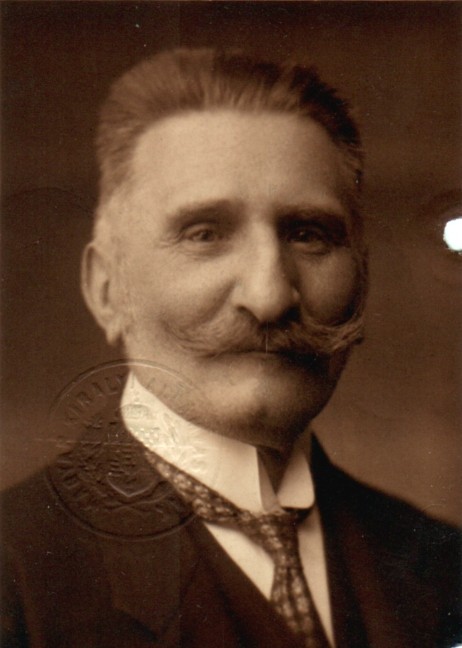
Hodinka Antal was born on 12 January 1864 into a family Greek Catholic priest (his father was Román Hodinka, 1836–1913) in the village of Ladomér, Zemplén. He graduated from the Royal Catholic Gymnasium of Uzhhorod in 1882, after which he pursued theological studies in Uzhhorod and Budapest. From the autumn of 1888 he worked at the National Széchényi Library, and later held a scholarship at the Austrian Historical Institute in Vienna. In 1891 he earned a doctoral degree at the Faculty of Humanities of the University of Budapest in Slavic philology, Hungarian history, and diplomatics, followed by a theological degree in 1896. Between 1892 and 1906 he served in Vienna as an archivist and librarian. In 1891–1892 he worked under the supervision of the historian Lajos Thallóczy in the archives of the joint Austro-Hungarian Ministry of Finance in Vienna, and from 1892 to 1906 he was the only Hungarian librarian of Emperor and King Franz Joseph’s entailed private library. In 1905 he obtained habilitation at the Faculty of Humanities of the University of Budapest in the field of Hungarian–Slavic historical relations. From 1906 he was a professor at the Law Academy in Pressburg (Bratislava), and from 1916 at the Elisabeth University in the same city. In 1920 he left Pressburg and worked temporarily in Budapest, then from 1923 in Pécs, where he served as dean of the Faculty of Humanities in the academic year 1926/27 and was elected Rector of the re-established Elisabeth University in the academic year 1932/33. He moved to Budapest in retirement in 1934 and continued his scholarly work there. Between 1941 and 1943 he became the first president of the Subcarpathian Scientific Society, which also fulfilled academic functions. He was elected a corresponding member of the Hungarian Academy of Sciences in 1910 and a full member in 1933. He died in Budapest on 15 July 1946.
His academic work can be divided into three major thematic areas:
- the history of Slavic–Hungarian relations
- the history of the city of Pécs
- the ecclesiastical and secular history of the Rusyns of Transcarpathia
Major works
- A rutének (The Ruthenians)
- Cseh források (Czech Sources)
- A szerb fejedelemség viszonya Magyarországhoz (Bp., 1889) (The Relationship of the Serbian Principality to Hungary)
- A szerb történet forrásai és az első kora (1891) (Sources of Serbian History and Its Early Period)
- Szláv források (1898) (Slavic Sources)
- A munkácsi görög-katholikus püspökség története (Bp., 1909) (History of the Greek Catholic Diocese of Mukachevo)
- Egyházunk küzdelme a boszniai bogumil eretnekekkel (191?) (Our Church’s Struggle with the Bosnian Bogomil Heretics)
- A Munkácsi görög szertartású püspökség okmánytára (1911–) (Documentary Collection of the Greek Rite Diocese of Mukachevo)
- Kálmán királyunk 1099-iki perenysli csatája (1914) (King Coloman’s Battle of Peremyshl in 1099)
- Az orosz évkönyvek magyar vonatkozásai (1916) (Hungarian References in the Russian Chronicles)
- A római levéltárak és könyvtárak ismertetése (1917–) (Description of the Roman Archives and Libraries)
- Adalékok az ungvári vár és tartománya és Ungvár város történetéhez (1917) (Contributions to the History of Uzhhorod Castle, Its Domain, and the City of Uzhhorod)
- A kárpátaljai rutének lakóhelye, gazdaságuk és múltjuk (Bp., 1923) (The Settlements, Economy, and Past of the Ruthenians of Transcarpathia)
- A muszka könyvárusok hazánkban (Russian Book Traders in Our Country)
- A magyarországi rutén letelepülések története (History of Ruthenian Settlements in Hungary)
- Négy egykorú jelentés az 1704-i pécsi rácz dúlásról (1932) (Four Contemporary Reports on the Serbian Devastation of Pécs in 1704)
- A töröktől visszafoglalt Pécs első fele (1934) (The First Period of Pécs after Its Recapture from the Turks)
- Ami a karlócai békekötésből kimaradt és következményei (Pécs, 1935) (What Was Omitted from the Treaty of Karlowitz and Its Consequences)
- II. Rákóczi Ferenc fejedelem és a „gens fidelissima” (1937) (Prince Francis II Rákóczi and the “Gens Fidelissima”)
- Szent István emlékezete és királyságának eszméje a szlávoknál (Bp., 1938) (The Memory of Saint Stephen and the Idea of His Kingship among the Slavs)
- Adalékok Pécs város történetéhez 1686–1701-ig (1943) (Contributions to the History of the City of Pécs, 1686–1701)
- Ruszin–magyar igetár (1945) (Ruthenian–Hungarian Verb Dictionary)